Draft for review. Not yet approved by the congregation for publication.

Holmdel Community United Church of Christ · Holmdel, New Jersey

Older than the county.
Lit by Tiffany.

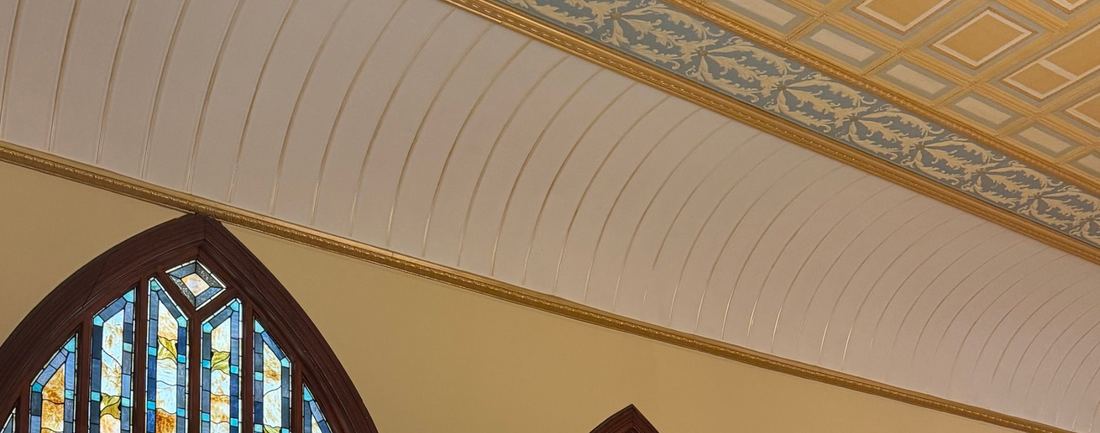
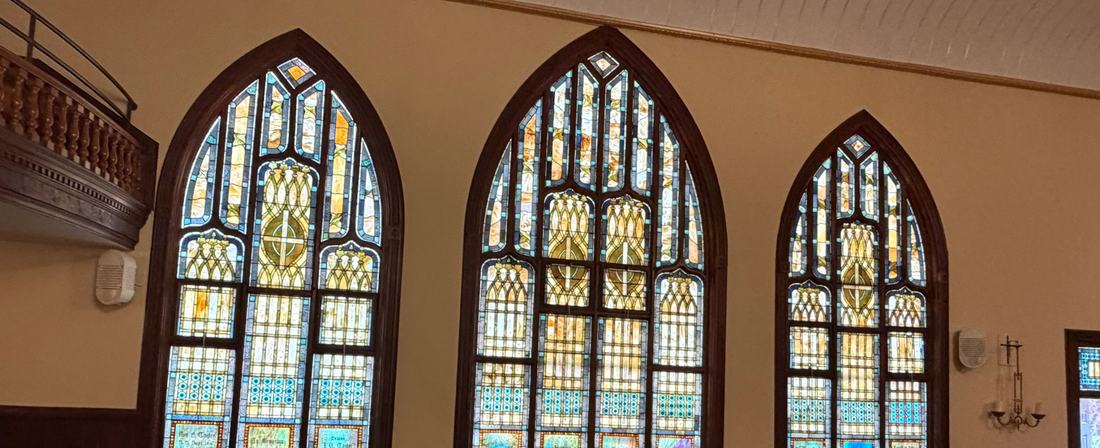
The people who founded Monmouth County founded this congregation, in 1668, fifteen years before the county existed. In 1893 its people filled their meeting house with Tiffany glass and wrote their founders' names into it. Take the tour, then help keep the light on.

Start the tourMeet the foundersHelp save the windows

The tour

Walk through the history, from the founders to today

Read the narration

    Use the buttons, the numbered stops, or the left and right arrow keys.

    Roots

    Here before Monmouth County was

    Scroll sideways through three and a half centuries on one piece of ground.

    1. 1665

      A charter for conscience

      On 8 April 1665 the Monmouth Patent granted twelve men the land that became this county, with freedom of religion written in a century before the Bill of Rights. Two of the twelve are this church's people: John Bowne, believed to have been its first preacher, and Obadiah Holmes, whose family names the town. [39][3]

    2. 1668

      New Jersey's first Baptists

      Settlers from Long Island and New England organised the first Baptist society in New Jersey here in Monmouth. [3]

    3. 1683

      The county is born

      Monmouth County was established on 7 March 1683. The congregation was already fifteen years old. [40]

    4. 1688

      A church is constituted

      The Baptist Church of Middletown was formally constituted, one of the earliest Baptist churches in the colonies. This was its Upper Meeting. [3]

    5. 1705

      John Bray gives the land

      John and Susanna Bray conveyed about four and one third acres for a Baptist meeting house. The church still stands on it. [3]

    6. 1781

      Revolution on the road outside

      British raiders marched on the road to Bray's Meeting House. Two soldiers of the Revolution, Lt. John Whitlock and Col. Asher Holmes, lie in the churchyard. [36][3]

    7. 1809

      The building you see

      The present meeting house was dedicated on 29 October 1809. [3]

    8. 1815

      A first Sunday school

      Ann B. Taylor opened the first Baptist Sunday school in New Jersey on her farm near the church. Her name is on Window A. [3]

    9. 1857

      A township named Holmdel

      Holmdel Township was set off and named for the Holmes family. [31]

    10. 1893

      Tiffany's windows

      The church reopened on 30 July 1893 with memorial windows that appear in Tiffany's own published lists. [1]

    11. 1990

      On the National Register

      The meeting house was entered on the National Register of Historic Places, three years after the state register. [4]

    A president's ancestors

    John Bowne, patentee of 1665 and the congregation's first preacher, married Lydia Holmes. The church's National Register nomination says that through their daughter Sarah (Bowne) Salter they were paternal ancestors of Abraham Lincoln. It also names Sarah (Holmes) Salter's as the earliest stone in the cemetery, where the earliest dated tombstone is from 1757 [3].

    The founders

    The people who founded Monmouth County founded this church

    Monmouth County began as the Monmouth Patent of 1665, a grant to twelve men [39]. Three years later, eighteen men formed the first Baptist society in New Jersey [3]. Put the two lists side by side and four names appear on both [45].

    Patentee and founding Baptist Patentee

    • John Bowne
    • Richard Stout
    • James Grover
    • Obadiah Holmes
    • William Goulding
    • Samuel Spicer
    • Richard Gibbons
    • John Tilton
    • Nathaniel Sylvester
    • William Reape
    • Walter Clark
    • Nicholas Davis

    Patentee · first preacher

    John Bowne

    One of the twelve, and believed to have been the Baptist society's first preacher. The historian John Stillwell called him "perhaps, the most conspicuous figure in the early history of Monmouth County" [3]. Family histories and Wikipedia agree that he was Speaker of the East Jersey Assembly in the early 1680s, including 1683, the year the county was created [47]. That is likely, and not yet checked against the Assembly's own records.

    Patentee · founding member

    Richard Stout

    One of the twelve, he helped lay out Middletown's lots and, by a family-history account, sat in the first General Assembly in 1671. He and his son John are among the eighteen founding Baptists [45][48]. Family tradition says the society was organised in the Stouts' kitchen [48].

    Patentee · founding member

    James Grover

    One of the twelve and Middletown's first town clerk. He and his son James are both on the list of founding Baptists [45][49].

    Patentee · the town's namesake family

    Obadiah Holmes

    A Baptist minister whipped in Boston for his beliefs, and one of the twelve [46]. There is no record that he lived here himself; his son Jonathan did. Jonathan Holmes held office in Middletown as deputy, justice and constable, and in 1667 he and his brother bought 1,600 acres [3]. Holmdel is named for the family [31].

    Second preacher · assemblyman

    James Ashton

    The society's second preacher and its first ordained one. He was a deputy to the General Assembly in 1669 and a grantee of Middletown and Shrewsbury in 1672 [3].

    Giver of the ground

    John Bray

    In 1705 he and his wife Susanna gave the land this church stands on. It stayed in Baptist hands until 1968 [3].

    The most direct tie

    One man at both beginnings

    East Jersey's four counties, Monmouth among them, were formalised on 7 March 1683 [50]. John Bowne held the 1665 patent, is believed to have preached to the first Baptists, and by several accounts was Speaker of the Assembly in 1683 [3][47]. If the Assembly's records bear that out, the congregation's first preacher presided when Monmouth County was made.

    How sure this is: the patent and the county's date rest on strong sources. The Speaker claim rests on family histories and Wikipedia. Richard Stout, James Grover and Obadiah Holmes are tied to the 1665 grant and the first towns, not to the act of 1683. Maxine Lurie's article "The Case of the Founding of Monmouth County" is the scholarly account to read next [51].

    From the founders to the glass

    The 1893 windows carry these families forward. The Holmes window names the patentee's descendants. The two Bray windows mark the gift of 1705. A Whitlock was among the eighteen founders, and Lt. John Whitlock of the Revolution lies in the churchyard [45][3]. A Mount was among the eighteen too, and Sheriff John J. Ely married Achsah Mount [45][32]. Whether those later families descend from the founders of the same name has not been traced.

    Two points of care. This congregation and Old First Church in Middletown were one church with two meeting houses until 1836, so they share this founding [4][31]. And the county was formalised on 7 March 1683 [40][50]; "founders" here means the patentees and first settlers of 1665. The list of eighteen may name Obadiah Holmes the son, not the father.

    The maker

    Why a Tiffany window is different

    He changed the glass itself

    Stained glass had barely changed since the Middle Ages: flat coloured panes with details painted on. Louis Comfort Tiffany and his rival John La Farge put the colour, streaks and texture inside the glass [41].

    He ran the biggest studio in America

    By the 1880s Tiffany's company was the largest producer of stained-glass windows in the country [44]. Holmdel appears in its published lists of 1897 and 1910 [1].

    Not everyone approved

    Makers in the Gothic tradition rejected opalescent glass outright [42]. Taste in church glass changed, which makes the opalescent windows that survive worth protecting.

    Go deeper on Tiffany

    These windows have lasted 133 years. The next hundred are up to us.

    Saving the windowsRead the full records